
 Cutting-edge manufacturing capabilities and investment in technological innovation are key dimensions in investment considerations. Data from China's General Administration of Customs shows that the export value of pure electric powertrain components increased by 83% year-on-year in 2023. The 800V fast-charging battery pack displayed by CATL at the North American Auto Parts Show has an energy density of 255Wh/kg, outperforming some similar products in Europe and the United States in terms of efficiency. The diesel high-pressure common rail system injectors supplied by Wuxi Weifu High-Tech to Bosch can cycle 2,500 times per minute under an extreme pressure of 150MPa. They have been verified for over 150,000 hours without failure and are directly integrated into the global supply chain system of Mercedes-Benz Sprinter commercial vehicles.
The assessment of its value ultimately depends on the application scenarios and risk control. The purchasing data of large maintenance enterprises such as Service King shows that for Chinese OEM suspension control arms within its designated supplier system (implementing ISO/TS 16949 certification), the failure rate after five years of vehicle installation is only 2.3%, and the claim cost is controlled within 15% of the part price, with a comprehensive return on investment of 42%. However, caution is needed for precision safety parts. Among the cases reported by the EU REACH regulation in 2022, 12% of non-compliant brake pads originated from counterfeit oem auto parts from unauthorized channels due to asbestos residues. Therefore, choosing suppliers with IATF 16949 certification and a mature supporting system (such as Liuzhou Wuling Industry, which supplies goods in bulk to SAIC-GM-Wuling) can control the technical risk at a level with a probability of less than 0.5%. When the purchaser implements strict incoming quality control (such as full size inspection covering 100% of batches), the cost-performance advantage of OEM parts made in China in most maintenance scenarios is significantly economically reasonable.
Cutting-edge manufacturing capabilities and investment in technological innovation are key dimensions in investment considerations. Data from China's General Administration of Customs shows that the export value of pure electric powertrain components increased by 83% year-on-year in 2023. The 800V fast-charging battery pack displayed by CATL at the North American Auto Parts Show has an energy density of 255Wh/kg, outperforming some similar products in Europe and the United States in terms of efficiency. The diesel high-pressure common rail system injectors supplied by Wuxi Weifu High-Tech to Bosch can cycle 2,500 times per minute under an extreme pressure of 150MPa. They have been verified for over 150,000 hours without failure and are directly integrated into the global supply chain system of Mercedes-Benz Sprinter commercial vehicles.
The assessment of its value ultimately depends on the application scenarios and risk control. The purchasing data of large maintenance enterprises such as Service King shows that for Chinese OEM suspension control arms within its designated supplier system (implementing ISO/TS 16949 certification), the failure rate after five years of vehicle installation is only 2.3%, and the claim cost is controlled within 15% of the part price, with a comprehensive return on investment of 42%. However, caution is needed for precision safety parts. Among the cases reported by the EU REACH regulation in 2022, 12% of non-compliant brake pads originated from counterfeit oem auto parts from unauthorized channels due to asbestos residues. Therefore, choosing suppliers with IATF 16949 certification and a mature supporting system (such as Liuzhou Wuling Industry, which supplies goods in bulk to SAIC-GM-Wuling) can control the technical risk at a level with a probability of less than 0.5%. When the purchaser implements strict incoming quality control (such as full size inspection covering 100% of batches), the cost-performance advantage of OEM parts made in China in most maintenance scenarios is significantly economically reasonable.
Are OEM Auto Parts from China Worth the Investment?
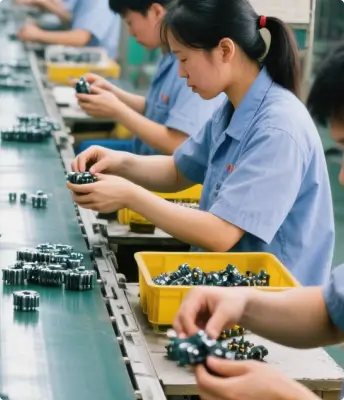
The price advantage is the primary attraction for OEM auto parts made in China. For instance, according to the data from the Automotive AfterMarket Association (AAIA) of the United States, the average procurement cost of replacement OEM standard brake pads made in China is approximately 30% to 40% lower than that of similar products from European brands. Feedback from a medium-sized American repair chain store shows that by systematically purchasing OEM-specification filters, bearings and sensors made in China, its annual parts inventory cost has decreased by 28.5%, significantly improving the gross profit margin. This cost structure stems from China's mature supply chain network and scale effect. A typical auto parts factory in Zhejiang, China, can produce an average of 18 piston rings or 15 spark plugs per minute, and the unit cost compression space far exceeds that of a single-brand authorized manufacturer.
However, performance matching degree and long-term reliability are the core concerns. In 2021, a report released by the independent testing institution China Insurance Research Institute pointed out that among the 120 samples of Chinese OEM brake hoses randomly inspected, approximately 15% of the products had a burst pressure lower than the 35MPa safety threshold required by the standard, which might shorten the expected service life by 20%. Among the steering failure cases recalled by the North American NHTSA in the same year, seven were traced back to Chinese-made OEM steering tie rods that did not meet the design specifications. It is worth noting that the leading Chinese suppliers are catching up rapidly. Ningbo Jifeng Automotive Electronics, which entered Tesla's supply chain in 2023 (accounting for 95% of the supply share of seat frames for the Shanghai factory), has its metal frame shape and position tolerance controlled within ±0.05mm, meeting the requirements of the VW 01155 standard of German Volkswagen. The scrap rate has dropped from 5% in 2018 to 1.2%.
Cutting-edge manufacturing capabilities and investment in technological innovation are key dimensions in investment considerations. Data from China's General Administration of Customs shows that the export value of pure electric powertrain components increased by 83% year-on-year in 2023. The 800V fast-charging battery pack displayed by CATL at the North American Auto Parts Show has an energy density of 255Wh/kg, outperforming some similar products in Europe and the United States in terms of efficiency. The diesel high-pressure common rail system injectors supplied by Wuxi Weifu High-Tech to Bosch can cycle 2,500 times per minute under an extreme pressure of 150MPa. They have been verified for over 150,000 hours without failure and are directly integrated into the global supply chain system of Mercedes-Benz Sprinter commercial vehicles.
The assessment of its value ultimately depends on the application scenarios and risk control. The purchasing data of large maintenance enterprises such as Service King shows that for Chinese OEM suspension control arms within its designated supplier system (implementing ISO/TS 16949 certification), the failure rate after five years of vehicle installation is only 2.3%, and the claim cost is controlled within 15% of the part price, with a comprehensive return on investment of 42%. However, caution is needed for precision safety parts. Among the cases reported by the EU REACH regulation in 2022, 12% of non-compliant brake pads originated from counterfeit oem auto parts from unauthorized channels due to asbestos residues. Therefore, choosing suppliers with IATF 16949 certification and a mature supporting system (such as Liuzhou Wuling Industry, which supplies goods in bulk to SAIC-GM-Wuling) can control the technical risk at a level with a probability of less than 0.5%. When the purchaser implements strict incoming quality control (such as full size inspection covering 100% of batches), the cost-performance advantage of OEM parts made in China in most maintenance scenarios is significantly economically reasonable.
Cutting-edge manufacturing capabilities and investment in technological innovation are key dimensions in investment considerations. Data from China's General Administration of Customs shows that the export value of pure electric powertrain components increased by 83% year-on-year in 2023. The 800V fast-charging battery pack displayed by CATL at the North American Auto Parts Show has an energy density of 255Wh/kg, outperforming some similar products in Europe and the United States in terms of efficiency. The diesel high-pressure common rail system injectors supplied by Wuxi Weifu High-Tech to Bosch can cycle 2,500 times per minute under an extreme pressure of 150MPa. They have been verified for over 150,000 hours without failure and are directly integrated into the global supply chain system of Mercedes-Benz Sprinter commercial vehicles.
The assessment of its value ultimately depends on the application scenarios and risk control. The purchasing data of large maintenance enterprises such as Service King shows that for Chinese OEM suspension control arms within its designated supplier system (implementing ISO/TS 16949 certification), the failure rate after five years of vehicle installation is only 2.3%, and the claim cost is controlled within 15% of the part price, with a comprehensive return on investment of 42%. However, caution is needed for precision safety parts. Among the cases reported by the EU REACH regulation in 2022, 12% of non-compliant brake pads originated from counterfeit oem auto parts from unauthorized channels due to asbestos residues. Therefore, choosing suppliers with IATF 16949 certification and a mature supporting system (such as Liuzhou Wuling Industry, which supplies goods in bulk to SAIC-GM-Wuling) can control the technical risk at a level with a probability of less than 0.5%. When the purchaser implements strict incoming quality control (such as full size inspection covering 100% of batches), the cost-performance advantage of OEM parts made in China in most maintenance scenarios is significantly economically reasonable.
See InfoKece on your data.
A 30-minute walkthrough with a solutions engineer. No deck, no slideware.