
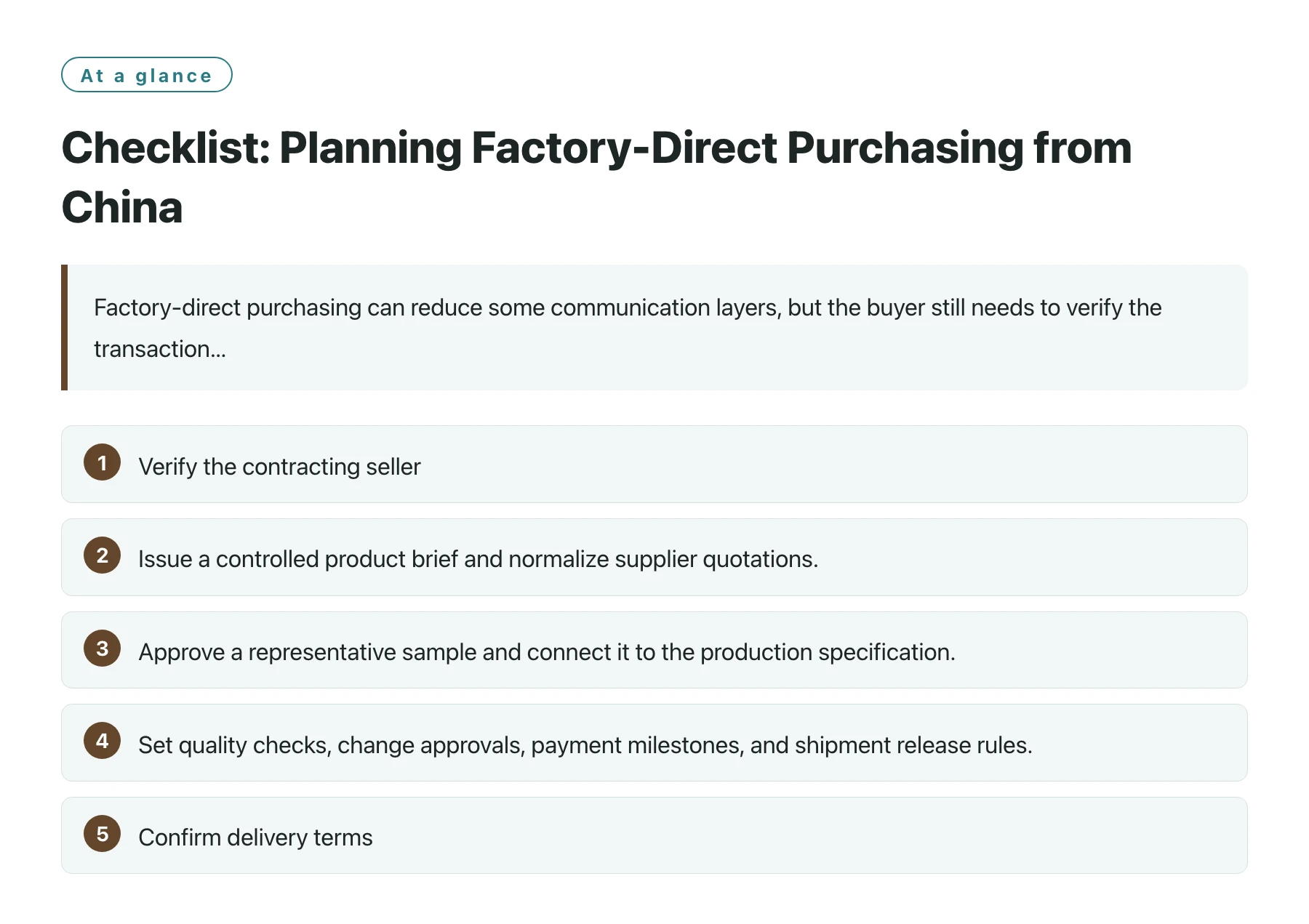
Factory-direct purchasing can reduce some communication layers, but the buyer still needs to verify the transaction parties, define the exact product, compare complete offers, control samples and changes, and assign shipping and release responsibilities. A stage-based checklist makes those controls easier to apply before a deposit, during production, and before cargo leaves the factory.
Key takeaways
- Verify the contracting seller, manufacturing site, payment recipient, and outsourced processes.
- Issue a controlled product brief and normalize supplier quotations.
- Approve a representative sample and connect it to the production specification.
- Set quality checks, change approvals, payment milestones, and shipment release rules.
- Confirm delivery terms, required documents, route, and receiving plan before booking.
Use the checklist as a decision aid; product-specific technical and market requirements still need qualified review.
Before requesting a price
Write down product purpose, destination market, quantity, variants, material, dimensions, finish, accessories, packaging, quality requirements, and required arrival date. Identify which details are fixed and which need supplier input. Give every candidate the same specification revision and response deadline. If the buyer’s team has not decided a technical point, label it as open instead of silently allowing each supplier to assume something different.
Decide which suppliers are eligible to quote and what evidence is needed: legal seller identity, factory site, relevant process capability, subcontracted work, technical documents, sample availability, and capacity. Separate identity verification from product qualification. A company can be real while the proposed site or capability is still unverified.
Buyers sourcing manufacturers in China should maintain a shortlist record with contact, seller role, factory location, evidence received, questions, and decision owner. Keep the source of each claim visible so the team knows whether it came from a document, site visit, supplier statement, or independent check.
Before selecting a supplier
Match the proposed seller, factory, payment recipient, and export party. Ask which entity signs the purchase agreement and who is accountable for production, defects, warranty, and corrective action. Record any trading company or intermediary role and how it is compensated. Confirm how the buyer can communicate with production and quality staff when an issue arises.
Normalize quotations to the same model, revision, quantity, packaging, inspection, payment, delivery point, and date. Check minimum order, tooling, sample charges, validity, currency, lead time, exclusions, and commercial assumptions. Request alternate materials or configurations on separate lines. Compare the total scope rather than a headline unit price.
Review quality-system or supplier certificates within their stated scope. ISO 9001 describes requirements for a quality-management system, but a management-system certificate does not itself demonstrate that a particular product meets the buyer’s specification. Verify issuer, scope, site, status, and product-specific evidence separately. [1]
Before paying a deposit
Use a written purchase agreement and order that identify seller, buyer, factory, product model, drawing revision, materials, quantity, unit price, currency, payment milestones, delivery term, named place, and required date. Attach the current specification and approved quotation. State that production changes need documented review when they affect the accepted product or evidence.
Confirm payment instructions through a known contact route. Match the account name to the contractual party or obtain an explanation that finance can verify. Define deposit basis, balance trigger, refund conditions, bank fees, tooling costs, and who owns custom tooling. For material advance payments, ask procurement, finance, and legal reviewers to assess recovery rights and evidence conditions.
Tie each payment milestone to something observable, such as sample approval, tooling inspection, material readiness, a production milestone, or final inspection disposition. State what record is required, who reviews it, and how exceptions are handled. A milestone like “when ready” is too vague to guide a payment decision.
Before approving a sample
Label the sample with supplier, factory, model, revision, materials, date, purpose, and any differences from production. Compare it with the agreed brief and evaluate dimensions, fit, operation, finish, components, accessories, instructions, and packaging as relevant. Take photographs and record the exact attributes reviewed.
Route decisions to the right reviewers: product, engineering, compliance, design, quality, or installation. State whether approval covers appearance only, the complete function, or a specific configuration. List open items and due dates. A physical sample cannot prove factory capacity, routine production consistency, every destination-market requirement, or the condition of a future shipment.
Keep a controlled reference and require written approval before production. If the supplier proposes a revised sample, distinguish the old and new versions and compare the change. Tell the factory which sample or drawing governs production and how it will be available to inspectors.
Before and during production
Confirm the production site, schedule, material sources, quantity, and controls for critical features. Ask how work instructions and approved revisions reach the line, how incoming materials are checked, and how nonconforming goods are contained. The supplier should identify outsourced work and how it controls changes at subcontractors.
Set a change process for materials, components, finish, factory, process, tooling, packaging, and test methods. Require written notice, technical impact, price and schedule effect, evidence, and buyer decision before implementation. Assign a named approver. A supplier’s schedule or material constraint should trigger a proposal, not an assumed substitution.
Set production updates with planned date, forecast, actual progress, blocker, owner, and decision needed. Ask the factory to report a delay when known. Track buyer-dependent dates such as artwork, samples, and instructions so the project can distinguish a supplier issue from a late approval.
Before shipment release
Define inspection timing, scope, sample method, product checks, acceptance criteria, report, and who may release goods. Include product identity, function, dimensions, appearance, accessories, labels, packaging, and documents as appropriate. If a characteristic needs lab testing or specialist review, arrange it separately and tie the result to the exact model and lot.
Review findings against the written criteria. Decide release, hold, rework, replacement, concession, or re-inspection and record who approved the disposition. Confirm quantity, product revision, labels, carton marks, packing list, invoice, and required product records. Do not treat factory readiness or an inspection summary as the buyer’s shipment authorization.
Confirm pickup, export handling, freight, insurance, customs, destination delivery, unloading, and appointment responsibilities. State the delivery term and precise named place in the contract. Get route, package dimensions, gross weights, cargo restrictions, and delivery date from the actual shipment.
Before the first order is closed
At receiving, compare goods with purchase order, inspection disposition, packing list, lot identifiers, and approved sample. Record visible damage, shortages, or mismatched labels before goods are mixed into inventory. Preserve photographs and packaging where a claim or investigation may need them.
Reconcile actual costs and delivery against the quotation. Identify freight, storage, inspection, rework, tooling, destination charges, and other variance. Distinguish supplier, buyer, carrier, customs, and external causes. The final cost record will improve the next quotation comparison.
Review quality, communication, schedule, documentation, and corrective actions by product, site, and lot. Update qualification, specification, inspection, and change controls for repeat orders. Keep the review factual and specific; one shipment is evidence about that transaction, not a universal guarantee for every future order.
Sources
Frequently asked questions
What is the first step in factory-direct purchasing?
First, define product purpose, specification, market, quantity, quality checks, evidence, delivery point, and arrival date so manufacturers can quote on a comparable basis.
Does factory-direct mean the factory is the seller?
Not necessarily. Verify the contracting seller, producing site, payment recipient, exporter, intermediaries, and each party’s responsibility for subcontracted work.
What should be attached to the purchase order?
Attach the current specification, accepted sample reference, supplier quotation, packaging requirements, inspection plan, named delivery term, and written change-approval process.
Can a supplier ship once production is complete?
Only after the agreed inspection, open findings, documents, quantity, packaging, and buyer release conditions for the identified lot are resolved.