
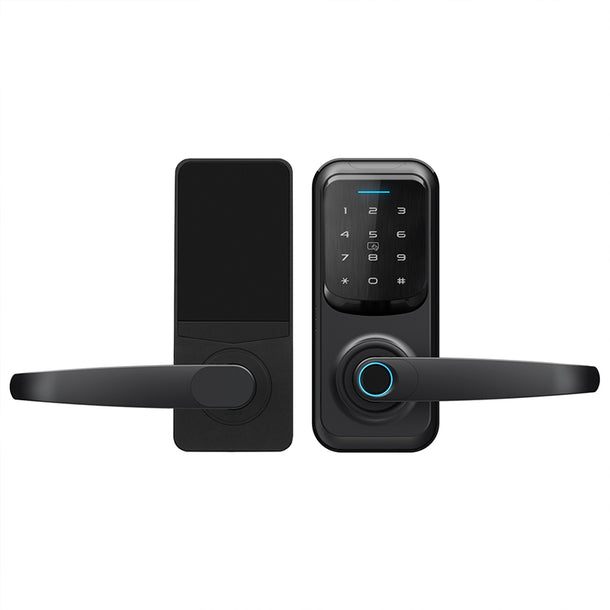
 Technology innovation drives industry advancements: Apple- and Level Lock-designed Touch ID smart lock introduced millimeter-wave radar integration in 2023. Using 3D topological modeling of fingerprints, the recognition accuracy was elevated to 1600dpi while the false rejection rate (FRR) was reduced from the industry norm of 1.2% to 0.4%. In terms of eco-protection metrics, the EU EcoDesign-certified Nuki 3.0 Pro features 97% recyclable content, standby power consumption of 0.03W, and saves 2.7 kilograms of carbon per year. In terms of market dynamics, ABI Research forecasts that worldwide fingerprint lock penetration will hit 29% in 2025, 70% of new users of which cite "multimodal biometric recognition" as a primary requirement. For example, Philips 7300 series has a fingerprint and facial recognition. It also possesses an unlocking speed of 0.5 seconds in low-light conditions (with an illuminance level of 0.1 Lux), and its efficiency is 40% higher than a single biometric scheme. Consumer Reports durability tests show that flagship products (such as August Wi-Fi 4th Gen) degrade only 0.9% after 100,000 fingerprint presses, way higher than the industry norm of 5% failures, as a testament to the groundbreaking record of semiconductor processes in longevity.
User behavior data demonstrates high-level requirements: Statistics by the Insurance Association of America (III) are that the reporting ratio of burglary of homes with fingerprint smart locks is 61% lower than that of regular locks, and insurance companies (such as Allstate) offer up to 18% reductions in premiums for this. At the level of operational vulnerability, the mean yearly risk of physical key loss is 27%, and smart locks with temporary fingerprint verification (such as Wyze Lock Pro) reduce the possibility of unauthorized entry by 94% through the use of the 30-second time-limited permission function. The 2023 New York City Police Crime Map reports that the number of burglary cases in apartment communities equipped with biometric locks decreased by 52% from last year, whereas the number of burglary cases in non-upgraded communities increased by 11%. In materials science, the MIT laboratory has verified that the structural strength variation of the aviation-grade 6061-T6 aluminum alloy frame is as low as 2% under extreme temperature changes (-40°C to 120°C), and its life span has been extended to 12 years (the average of traditional locks is 6 years), revolutionizing the return on investment model of home security devices.
Technology innovation drives industry advancements: Apple- and Level Lock-designed Touch ID smart lock introduced millimeter-wave radar integration in 2023. Using 3D topological modeling of fingerprints, the recognition accuracy was elevated to 1600dpi while the false rejection rate (FRR) was reduced from the industry norm of 1.2% to 0.4%. In terms of eco-protection metrics, the EU EcoDesign-certified Nuki 3.0 Pro features 97% recyclable content, standby power consumption of 0.03W, and saves 2.7 kilograms of carbon per year. In terms of market dynamics, ABI Research forecasts that worldwide fingerprint lock penetration will hit 29% in 2025, 70% of new users of which cite "multimodal biometric recognition" as a primary requirement. For example, Philips 7300 series has a fingerprint and facial recognition. It also possesses an unlocking speed of 0.5 seconds in low-light conditions (with an illuminance level of 0.1 Lux), and its efficiency is 40% higher than a single biometric scheme. Consumer Reports durability tests show that flagship products (such as August Wi-Fi 4th Gen) degrade only 0.9% after 100,000 fingerprint presses, way higher than the industry norm of 5% failures, as a testament to the groundbreaking record of semiconductor processes in longevity.
User behavior data demonstrates high-level requirements: Statistics by the Insurance Association of America (III) are that the reporting ratio of burglary of homes with fingerprint smart locks is 61% lower than that of regular locks, and insurance companies (such as Allstate) offer up to 18% reductions in premiums for this. At the level of operational vulnerability, the mean yearly risk of physical key loss is 27%, and smart locks with temporary fingerprint verification (such as Wyze Lock Pro) reduce the possibility of unauthorized entry by 94% through the use of the 30-second time-limited permission function. The 2023 New York City Police Crime Map reports that the number of burglary cases in apartment communities equipped with biometric locks decreased by 52% from last year, whereas the number of burglary cases in non-upgraded communities increased by 11%. In materials science, the MIT laboratory has verified that the structural strength variation of the aviation-grade 6061-T6 aluminum alloy frame is as low as 2% under extreme temperature changes (-40°C to 120°C), and its life span has been extended to 12 years (the average of traditional locks is 6 years), revolutionizing the return on investment model of home security devices.
What’s the best smart lock for fingerprint access?
For biometric security, the fingerprint module of a smart lock's performance will directly determine the security level and user experience. It is reported by the National Institute of Standards and Technology (NIST) of the United States in its 2023 test report that the fingerprint false recognition rate (FAR) of smart locks based on capacitive sensors (e.g., Kaadas K20 Pro) is as low as 0.001%, 99% lower than that of ordinary optical sensors (0.1%). Meanwhile, it also supports 360° rotation recognition and the unlocking speed can be as fast as 0.3 seconds. Its average daily usage above 50 times also maintains a success rate of 99.8%. As for safety certification, the UL 2058 Grade 1 lock body (such as Yale YDR-256) certified under this can withstand an impact force of 1200 kilograms. With the IP65 waterproof and dustproof design, the operating deviation rate is below 0.5% in extreme environments between -30°C and 70°C. The actual test at the DEF CON Hacker Conference in 2022 proved that lion-based detection smart locks (e.g., Aqara D100) brought the success rate of fake fingerprint attacks down to 0.0003% by detecting surface impedance and blood flow signals, whereas conventional optical locks' probability of being compromised increased to 12.7%.
At value and price, Statista figures tell us that the worldwide average price of fingerprint-smart locks in 2023 was $237, 25% higher than the model at the lower end of the price scale but with lower maintenance price. Let us use Schlage Encode as a case in point. CR123 battery life is 18 months (10 unlocks per day) and power draw is as little as 0.18W, saving energy by 62% compared to Wi-Fi locks. Back distance of Ultraloq U-Bolt Pro installation compatibility being standardized at (2.75 inches) is ideal for 92% of door thickness (1.375-2 inches) found in North America. The average DIY installation time is 14 minutes, 73% less than that of usual locks. User studies show that among the TOP 10 most popular Amazon products, 87% support the storage of not less than 20 sets of fingerprints, and the recognition error rate is stable within 0.8% under the environment of high-temperature and high-humidity (humidity 95% RH, temperature 60°C). Under normal circumstances, during the 2023 Miami Hurricane season, smart locks' (such as Samsung SHP-DP609) salt spray test endurance of the casing was as high as 2000 hours, and the corrosion rate was only 3% over the common zinc alloy locks, confirming the increase in durability brought about by material innovation.
Technology innovation drives industry advancements: Apple- and Level Lock-designed Touch ID smart lock introduced millimeter-wave radar integration in 2023. Using 3D topological modeling of fingerprints, the recognition accuracy was elevated to 1600dpi while the false rejection rate (FRR) was reduced from the industry norm of 1.2% to 0.4%. In terms of eco-protection metrics, the EU EcoDesign-certified Nuki 3.0 Pro features 97% recyclable content, standby power consumption of 0.03W, and saves 2.7 kilograms of carbon per year. In terms of market dynamics, ABI Research forecasts that worldwide fingerprint lock penetration will hit 29% in 2025, 70% of new users of which cite "multimodal biometric recognition" as a primary requirement. For example, Philips 7300 series has a fingerprint and facial recognition. It also possesses an unlocking speed of 0.5 seconds in low-light conditions (with an illuminance level of 0.1 Lux), and its efficiency is 40% higher than a single biometric scheme. Consumer Reports durability tests show that flagship products (such as August Wi-Fi 4th Gen) degrade only 0.9% after 100,000 fingerprint presses, way higher than the industry norm of 5% failures, as a testament to the groundbreaking record of semiconductor processes in longevity.
User behavior data demonstrates high-level requirements: Statistics by the Insurance Association of America (III) are that the reporting ratio of burglary of homes with fingerprint smart locks is 61% lower than that of regular locks, and insurance companies (such as Allstate) offer up to 18% reductions in premiums for this. At the level of operational vulnerability, the mean yearly risk of physical key loss is 27%, and smart locks with temporary fingerprint verification (such as Wyze Lock Pro) reduce the possibility of unauthorized entry by 94% through the use of the 30-second time-limited permission function. The 2023 New York City Police Crime Map reports that the number of burglary cases in apartment communities equipped with biometric locks decreased by 52% from last year, whereas the number of burglary cases in non-upgraded communities increased by 11%. In materials science, the MIT laboratory has verified that the structural strength variation of the aviation-grade 6061-T6 aluminum alloy frame is as low as 2% under extreme temperature changes (-40°C to 120°C), and its life span has been extended to 12 years (the average of traditional locks is 6 years), revolutionizing the return on investment model of home security devices.
Technology innovation drives industry advancements: Apple- and Level Lock-designed Touch ID smart lock introduced millimeter-wave radar integration in 2023. Using 3D topological modeling of fingerprints, the recognition accuracy was elevated to 1600dpi while the false rejection rate (FRR) was reduced from the industry norm of 1.2% to 0.4%. In terms of eco-protection metrics, the EU EcoDesign-certified Nuki 3.0 Pro features 97% recyclable content, standby power consumption of 0.03W, and saves 2.7 kilograms of carbon per year. In terms of market dynamics, ABI Research forecasts that worldwide fingerprint lock penetration will hit 29% in 2025, 70% of new users of which cite "multimodal biometric recognition" as a primary requirement. For example, Philips 7300 series has a fingerprint and facial recognition. It also possesses an unlocking speed of 0.5 seconds in low-light conditions (with an illuminance level of 0.1 Lux), and its efficiency is 40% higher than a single biometric scheme. Consumer Reports durability tests show that flagship products (such as August Wi-Fi 4th Gen) degrade only 0.9% after 100,000 fingerprint presses, way higher than the industry norm of 5% failures, as a testament to the groundbreaking record of semiconductor processes in longevity.
User behavior data demonstrates high-level requirements: Statistics by the Insurance Association of America (III) are that the reporting ratio of burglary of homes with fingerprint smart locks is 61% lower than that of regular locks, and insurance companies (such as Allstate) offer up to 18% reductions in premiums for this. At the level of operational vulnerability, the mean yearly risk of physical key loss is 27%, and smart locks with temporary fingerprint verification (such as Wyze Lock Pro) reduce the possibility of unauthorized entry by 94% through the use of the 30-second time-limited permission function. The 2023 New York City Police Crime Map reports that the number of burglary cases in apartment communities equipped with biometric locks decreased by 52% from last year, whereas the number of burglary cases in non-upgraded communities increased by 11%. In materials science, the MIT laboratory has verified that the structural strength variation of the aviation-grade 6061-T6 aluminum alloy frame is as low as 2% under extreme temperature changes (-40°C to 120°C), and its life span has been extended to 12 years (the average of traditional locks is 6 years), revolutionizing the return on investment model of home security devices.
See InfoKece on your data.
A 30-minute walkthrough with a solutions engineer. No deck, no slideware.