
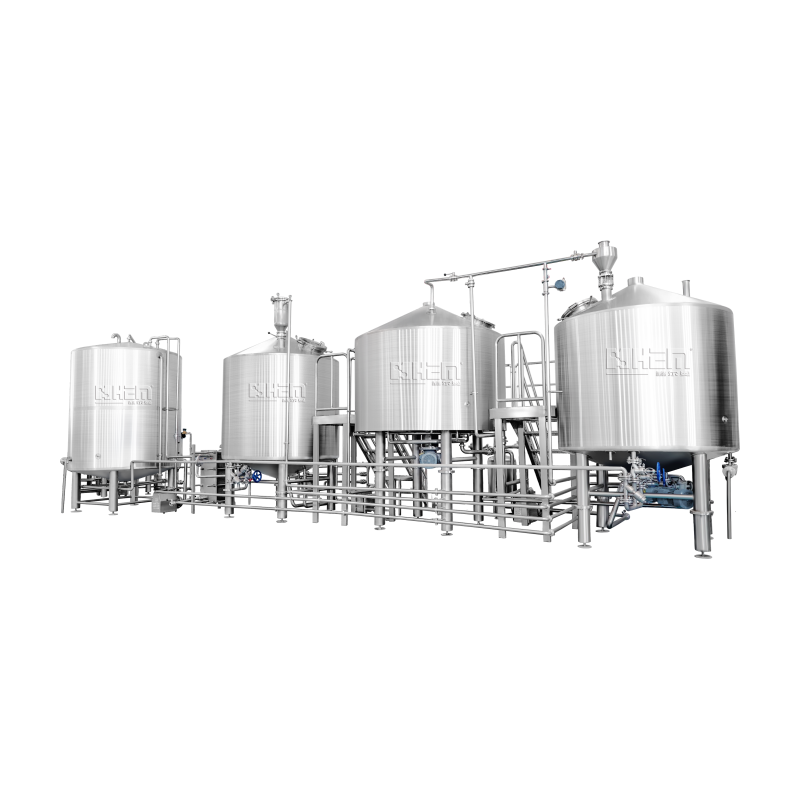
Stainless steel is preferred in breweries because it handles several jobs at once: food-contact hygiene, chemical cleaning, pressure, heat, cooling, and repeated production. Type 304 commonly contains about 18–20% chromium and 8–10.5% nickel, while 316/316L adds roughly 2–3% molybdenum for better resistance to chloride-related corrosion. Brewing also moves from mash temperatures near 63–72°C to wort boiling near 100°C, followed by rapid cooling and fermentation. Properly finished stainless surfaces can be repeatedly cleaned by CIP without coatings or absorbent materials. For commercial production, the practical advantage is repeatable sanitation and process control over thousands of batches.
The preference starts with corrosion behavior rather than appearance. Stainless steel forms a very thin chromium-rich passive oxide film when exposed to oxygen and water; if the surface is lightly damaged, that passive layer can form again under suitable oxidizing conditions. Nickel Institute technical guidance describes the film as only a few molecular layers thick, yet it is responsible for much of stainless steel’s resistance to normal food and beverage environments.
That chemistry explains why grade selection matters. ASTM-type 304 generally contains 18–20% chromium and 8–10.5% nickel, while 316 commonly contains 16–18% chromium, 10–14% nickel, and 2–3% molybdenum; the molybdenum improves resistance to pitting in chloride-containing environments. Nickel Institute data place typical PREN values around 19 for 304 and 25 for 316/316L, showing the difference in relative pitting resistance.
| Property | 304 stainless steel | 316/316L stainless steel |
|---|---|---|
| Chromium | 18–20% | 16–18% |
| Nickel | 8–10.5% | 10–14% |
| Molybdenum | Normally none | 2–3% |
| Typical PREN | ~19 | ~25 |
| Common brewery use | Tanks, piping, brewhouse vessels | More aggressive water or chemical conditions |
The higher PREN does not make 316 necessary everywhere. Type 304 remains the most common stainless alloy for food and beverage applications, and Nickel Institute describes it as the standard 18-8 or 18-10 family; 316 becomes more attractive where chlorides, water chemistry, location, or cleaning conditions increase corrosion exposure. Paying for 316 while leaving poor welds, crevices, or chemical residue in the system does not solve those fabrication problems.
Fabrication then becomes as important as alloy chemistry because beer touches welds, fittings, valve seats, manways, spray devices, and pipe transitions rather than a laboratory sample of flat steel. A 2,000 L fermenter can have many welded product-contact connections, and one rough weld or poorly drained pocket may be harder to clean than several square meters of properly finished wall.
Surface condition therefore deserves a numerical specification. Professional sanitary equipment is often specified by Ra, the arithmetic average surface roughness, measured in micrometers or microinches; ASME BPE has included dedicated requirements for metallic process-contact surface finishes, with its 2022 edition devoting an entire section to multiuse contact surfaces. Brewery buyers should ask for the stated Ra rather than accept “polished stainless steel” as a complete specification.
A smoother finish does not sterilize a tank by itself. It makes soils easier to reach with cleaning chemistry and mechanical flow, which leads directly to CIP design: the Brewers Association describes clean-in-place as a method of cleaning equipment interiors without major disassembly and notes that brewery CIP operates with corrosive chemicals, elevated temperatures, and pressure.
A sanitary vessel should be judged by the complete cleaning path: spray coverage, flow, temperature, chemical concentration, contact time, drainage, valve geometry, and the condition of every product-contact weld.
That point matters because cleaning performance is measurable. Brewers Association guidance for draught systems, for example, specifies acid-cleaner water at 80–110°F (27–43°C) and at least 15 minutes of recirculating contact or 20 minutes for static cleaning. Tank CIP programs use different parameters, but the same principle applies: concentration, temperature, time, and physical contact must be controlled rather than estimated.
Chemical compatibility follows from the same issue. Hydrochloric acid is specifically identified by the Brewers Association as corrosive to stainless steel in draught-cleaning guidance, so “stainless” should never be interpreted as resistance to every cleaner at every concentration. Chemical supplier instructions, alloy grade, solution temperature, chloride exposure, and rinse quality all need to agree with one another.
Repeated cleaning is only part of the operating cycle. A brewhouse commonly moves mash through roughly 63–72°C, raises wort toward 100°C at atmospheric boiling conditions, and then cools it to yeast-pitching temperature; an ale process may ferment around 18–22°C, while many lager processes operate considerably colder. A vessel therefore experiences repeated heating and cooling rather than one stable temperature.
Stainless steel is well suited to those cycles and can also be formed into heating surfaces, cooling jackets, coils, and heat exchangers. Some stainless alloys are designed for service far above brewery temperatures—in one Outokumpu example, a stabilized 304-type heat-resistant grade is specified for temperatures up to 800°C—so normal beer-production temperatures are modest from a metallurgical standpoint.
Temperature control becomes more important after wort enters the fermenter because yeast generates heat. A jacketed 2,000 L or 10,000 L fermenter can use multiple cooling zones, allowing glycol to remove heat through the stainless wall while a temperature probe and controller maintain the selected setpoint; separate zones also help when the beer level changes between batches.
Pressure adds another engineering requirement. Fermenters, unitanks, and bright beer tanks may hold CO₂ while beer is fermenting, conditioning, carbonating, or being transferred, so wall thickness cannot be chosen from tank capacity alone. Vessel diameter, material strength, head geometry, weld quality, jacket construction, design pressure, relief devices, and applicable pressure rules all affect the finished vessel.
A 10-bar pressure rating, for example, is not interchangeable with a 2-bar rating simply because both tanks use 304 stainless steel. Larger diameters increase membrane stress at the same internal pressure, which is why buyers should request design pressure, test pressure, relief-valve settings, and the applicable fabrication standard rather than relying on the phrase “pressure fermenter.”
Process connections deserve the same attention. A commercial vessel may include a sample valve, racking port, bottom outlet, CIP arm, temperature thermowell, pressure gauge, CO₂ inlet, carbonation stone, level sensor, manway, and several jacket connections; a brewery with 20 fermenters can therefore have hundreds of interfaces that require cleaning, inspection, and periodic gasket replacement.
Stainless fabrication makes those layouts practical because the material can be rolled, welded, machined, and formed into sanitary assemblies. ASME BPE, originally developed for industries requiring tightly controlled hygienic processing, covers materials, design, fabrication, inspection, testing, and certification rather than treating surface finish as an isolated feature.
The same design flexibility explains why stainless steel dominates larger commercial brewery equipment installations. A brewery can connect brewhouse vessels, whirlpools, plate heat exchangers, fermenters, bright tanks, pumps, and sanitary piping with compatible welded or removable fittings while leaving room for later cellar expansion.
Expansion matters because tank utilization controls how much beer a fixed cellar can hold. If a 20 hL brewhouse produces 2 batches per day but beer remains in a fermenter for 14 days, the fermentation side needs far more than one day of brewhouse volume; adding four 40 hL fermenters adds 160 hL of nominal cellar capacity without replacing the kettle or mash vessel.
Material durability also affects ownership cost. Stainless product-contact walls normally do not require paint, polymer liners, or flavor-neutral interior coatings, while the harder surface resists deep scratching better than many softer synthetic materials. Nickel Institute notes that stainless steel used in consumer and food-related applications is 100% recyclable at the end of service life.
Long service life still depends on maintenance. Gaskets, mechanical seals, valve seats, pump components, spray devices, sensors, and relief valves may need attention long before a well-made vessel shell does, so a brewery operating 300 production days per year should compare spare-part access and serviceability alongside stainless grade and purchase price.
Water and cleaning practices can change that service life considerably. A brewery using chloride-rich water, leaving concentrated cleaner on warm surfaces, or allowing stagnant solution to remain inside crevices creates a more demanding environment than a brewery with controlled water chemistry, complete drainage, documented chemical dosing, and consistent rinsing.
For that reason, useful purchase specifications go beyond “304 stainless.” A buyer can request the exact alloy for product-contact parts, sheet thickness, internal Ra, weld treatment, passivation procedure, working and test pressure, insulation thickness, jacket arrangement, valve manufacturer, gasket material, spray-device coverage, electrical supply, glycol conditions, and material certificates.
A short equipment comparison can then use measurable items rather than visual impressions:
-
confirm 304, 304L, 316, or 316L for every major product-contact component;
-
record the specified internal Ra rather than accepting the word “polished”;
-
verify working pressure and pressure-test documentation;
-
check whether 100% of internal surfaces receive effective CIP coverage;
-
compare vessel diameter and height with available floor loading and ceiling clearance;
-
calculate glycol, steam, hot-water, electrical, and compressed-air requirements before installation;
-
inspect drainability around outlets, sample ports, manways, and low points.
Documentation also matters when several vessels must behave alike. If 12 fermenters are ordered as one group, matching valve layouts, probe positions, cooling areas, surface specifications, and pressure ratings makes cleaning procedures and operator training more consistent; differences of only a few connection positions can complicate hose routing and CIP procedures across an otherwise identical cellar.
Brewers Association material published for a brewery food-safety program gives a useful example of validation rather than assumption: after allergen-beer production, the brewery tested its normal tank sanitation rinse using ELISA and surface swabs and reported no detectable allergenic material, so a proposed additional 10-minute caustic rinse was not required. The lesson is practical—cleaning performance can be verified with testing instead of relying on equipment appearance.
The same approach works when comparing a 1,000 L pilot fermenter with a 100 hL production tank. The larger vessel requires different jacket area, structural support, spray coverage, pipe sizing, cooling capacity, access, and pressure calculations even when both shells are made from 304 stainless steel; material name alone provides only one part of the engineering specification.
A brewery purchasing equipment in 2026 should therefore compare quoted systems line by line: alloy composition, surface finish, weld treatment, pressure documentation, cleaning geometry, cooling area, instrumentation, spare parts, utility demand, and fabrication records. Stainless steel earns its place in brewing when the alloy, fabrication, hygienic design, and operating procedure are specified together rather than purchased as a material label alone.