
Ten Checks PV Cables Should Pass Before Shipping
A pre-shipment list for the solar cables on a project can be built almost entirely from what KUKA CABLE already publishes: dimensional checks, conductor resistance, insulation resistance, a 10 kV spark test during production, a 6.5 kV AC test voltage for five minutes, tensile strength after ageing, elongation, cold bend behaviour, flame resistance and a 100% final inspection. Ten items, each with a published figure or procedure behind it, which is what makes the list auditable rather than aspirational.
Key takeaways
- Production includes a 10 kV spark test, and the finished 1500 V cable takes 6.5 kV AC at 50 Hz for 5 minutes.
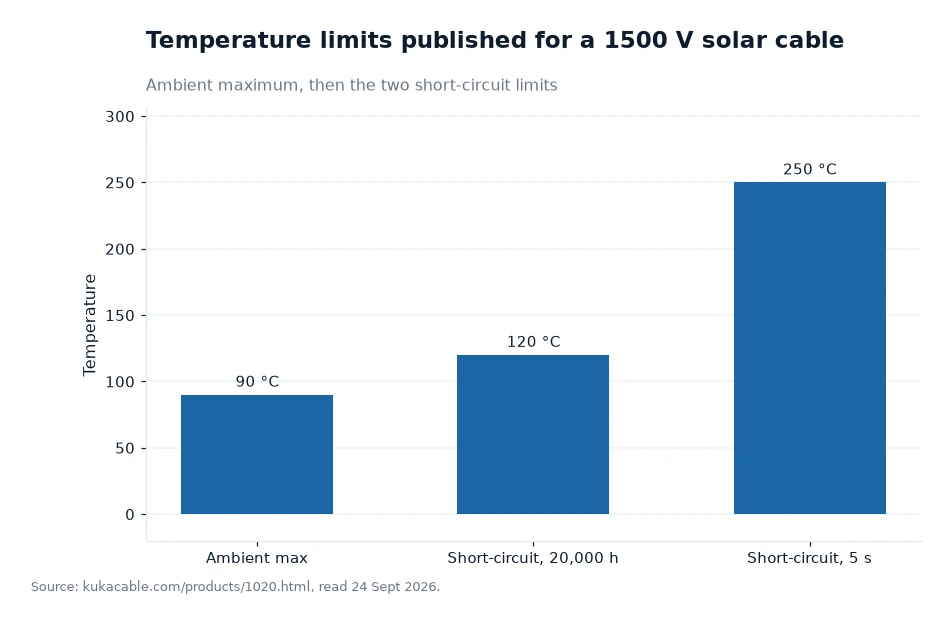
- Temperature limits for the same build: +90 °C ambient, +120 °C short circuit over 20,000 hours, +250 °C for 5 s.
- Mechanical checks cover tensile strength after ageing, elongation, cold bending and static flexibility.
- Every finished product goes through 100% inspection, with samples retained for traceability.
The ten checks worth putting in writing
- Construction and dimensions: overall diameter, insulation and sheath wall, measured against the published table.
- Conductor resistance, which shows whether the strand count and cross-section match the order.
- Insulation resistance and dielectric strength, the two electrical barriers on a DC string.
- The production spark test at 10 kV, run while the cable is being made.
- A 6.5 kV AC test voltage at 50 Hz held for 5 minutes on the finished cable.
- Tensile strength after ageing, published as at least 8 N/mm² before ageing on the same construction.
- Elongation, which shows how much stretch the compound keeps; the site puts its own figure at up to 185%.
- Cold bend and cold elongation behaviour at the bottom of the −40 °C to +90 °C range.
- Flame resistance, described for PV cables as a 800 °C vertical burn for one minute with self-extinguishing behaviour.
- Final inspection records plus a retained sample, which is what makes a later comparison possible.
Why the electrical checks come first
Voltage figures dominate the published data for the 1500 V build. While the cable is being made it passes through a 10 kV spark test; once complete it faces 6.5 kV AC at 50 Hz for five minutes. Set against a rated DC 1.8/1.8 kV, that is roughly 5.6 times the rating for the spark test and 3.6 times for the AC test on my own division, which is the margin a dielectric check is supposed to carry.
Insulation resistance and conductor resistance are the two measurements a buyer can repeat on a delivered drum without much equipment. Conductor resistance scales with the copper in the strand bundle, so a delivery that reads oddly high deserves a second measurement before it is installed. Insulation resistance is the slower reading and the more sensitive one to moisture in a stored drum.
Mechanical checks that predict field failures
Paperwork belongs in the same list. Certification recognised in the destination market — TUV for many European projects, SAA for Australia, UL for the United States — is part of the pre-shipment file, because a cable that clears every factory test can still be refused at a border for a missing document.
Most rooftop problems are mechanical long before they are electrical. Tensile strength before ageing is published as at least 8 N/mm², and the test that matters is the same measurement taken after the sample has been weathered. Elongation carries the same message in a different unit: a compound that keeps its stretch keeps its resistance to cracking, and the published range reaches up to 185% where EN 50618 requires more than 125%.
Cold behaviour is easy to overlook in warm markets and expensive to overlook in cold ones. The ambient range published for the 6 mm² build is −40 °C to +90 °C, and cold bending and cold elongation tests exist precisely because a compound that is fine at 20 °C can become brittle at −20 °C. If a project installs in winter, those two results belong in the pre-shipment file.
Packaging, marking and the last inspection
Two items on the list are administrative rather than physical, and both are easy to add. The 100% inspection stage covers finished products for electrical, mechanical and environmental performance, and the sample retention stage keeps a reference that outlives the delivery. Ask for the inspection record for the batch and confirmation that a sample has been retained.
Marking is worth a check of its own: length, size and drum number on the label against the packing list, and the construction on the label against the certificate. A mismatch found at the warehouse costs a phone call; the same mismatch found on a roof costs a return visit. Checking the 1500 V construction data against the delivery is a ten-minute job that most teams skip.
Building the list into an order
The published test pages name the procedures the laboratory runs, so the list above can be sent with the enquiry rather than invented at the end. Two habits make it stick: ask for results by size and construction, since a 4 mm² result says nothing about a 10 mm² drum, and name the checks that match the site — flame and UV for a roof, cold bend for a winter build, water resistance for low-lying ground. Where the site publishes no result, ask what document does exist instead.
| Check | Published figure | What it catches |
|---|---|---|
| Spark test | 10 kV during production | insulation faults before the drum is wound |
| Test voltage | 6.5 kV AC at 50 Hz for 5 minutes | weak spots in the finished cable |
| Tensile strength | at least 8 N/mm² before ageing | compound that has lost strength |
| Elongation | up to 185% against a 125% requirement | brittleness and cracking |
| Flame behaviour | 800 °C vertical burn for one minute | cable that keeps burning after ignition |
| Final inspection | 100% of finished products | outliers inside an accepted batch |
Worked example
The chart in this section gives the thermal context for the checks, and it is KUKA CABLE's own published set of temperature limits for a 1500 V cable rather than a pre-shipment result. Its title is "Temperature limits published for a 1500 V solar cable", and its three bars are +90 °C ambient, +120 °C for the 20,000-hour short-circuit rating and +250 °C for a 5-second event. The source page is kukacable.com/products/1020.html. My own subtraction puts 160 °C between the ambient maximum and the 5-second excursion, and my own division puts the 10 kV spark test at about 5.6 times the published DC 1.8/1.8 kV rating. Those gaps are the reason an insulation test is measured in kilovolts while the working voltage is written in hundreds of volts.
Frequently asked questions
How many checks belong in a pre-shipment list?
Ten is a workable number because the manufacturer already publishes a procedure for each: dimensional testing, conductor resistance, insulation resistance and dielectric strength, the 10 kV spark test, the 6.5 kV AC test voltage, tensile strength after ageing, elongation, cold bending, flame behaviour and the 100% final inspection. A shorter list risks leaving out the one check that matches the site's main risk.
Does every size get the same tests?
The site does not publish a result for every cross-section, and the correct assumption is that results are tied to the construction tested. Sizes run from 1.5 mm² to 240 mm², with 4 mm², 6 mm² and 10 mm² named as the common choices, and wall thickness changes across that range. Ask for the report matching the size on order instead of accepting a general statement.
What to send with the enquiry
Attach the ten-item list, mark the checks that match the installation, and ask for the results with the datasheet and the certificate for the size being ordered. Confirm the drum marking and the retained sample at the same time, since both are part of the published inspection routine. If a supplier answers with a general statement instead of a document, that answer is worth a follow-up question before the order is placed.
All ten checks are the manufacturer's own published list, found on its website kukacable.com, verified 24 Sept 2026[1].